
There has been no shortage of questions from investors this summer.
What will higher oil prices mean for inflation? When will the U.S. Federal Reserve lower interest rates? Is the investment in artificial intelligence sustainable? Are valuations too high? What about geopolitical tension, defense spending, consumer debt, market leverage and the recent increase in new stock offerings?
They are all reasonable questions. Together, however, they can make the investment environment feel more complicated than it needs to be.
From my perspective, most of these questions eventually connect to three broad forces that drive equity markets: the direction of earnings, the direction of interest rates and the direction of investor sentiment.
Think of them as three dials on a dashboard. They rarely point in the same direction, and there is almost never a moment when all three are perfectly favorable.
That is an important point. Investing is relative. We are not waiting for the perfect market because a perfect market does not exist.
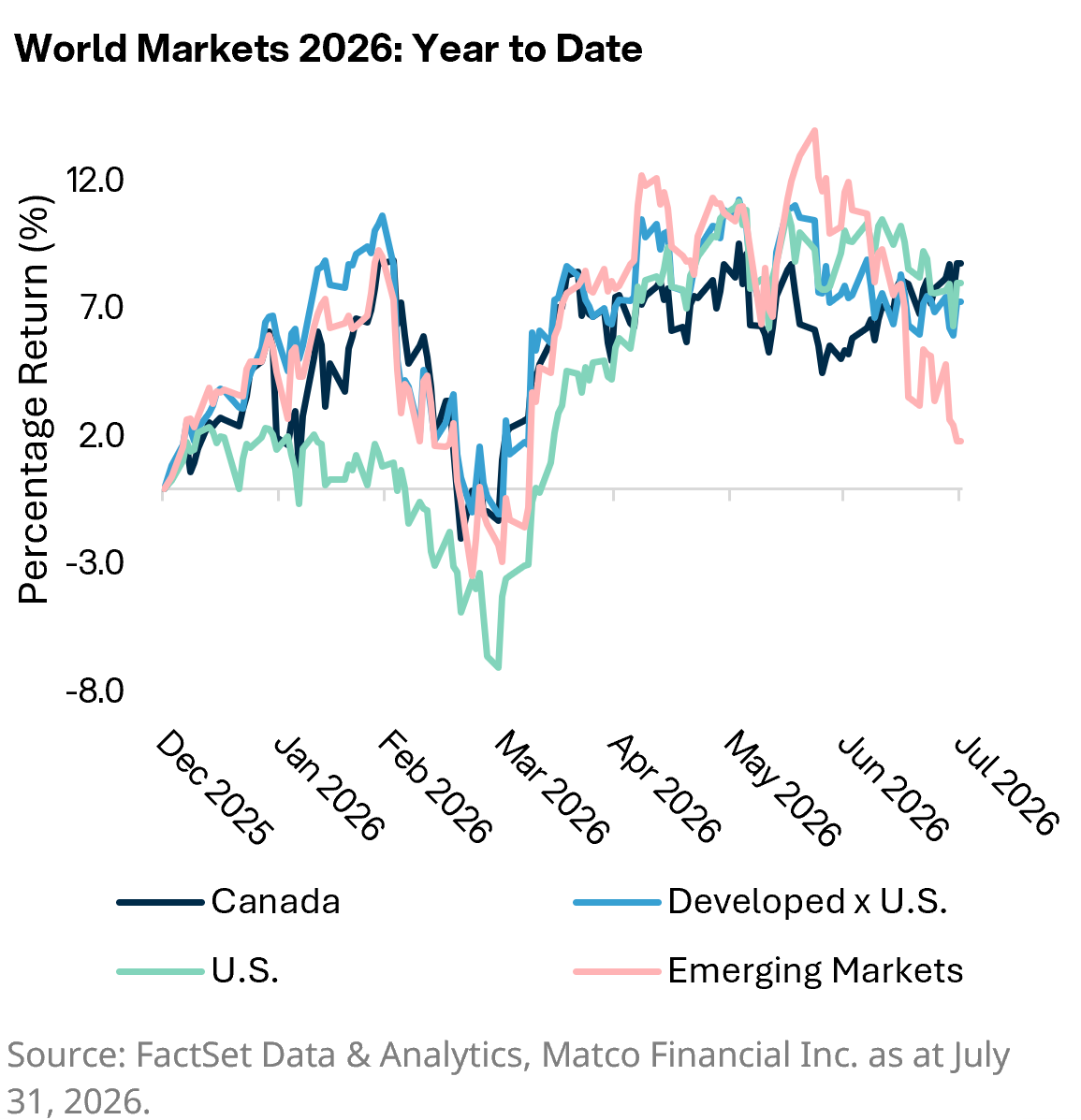
Dial One: Earnings
The first dial is earnings, and today it is giving us the most constructive reading.
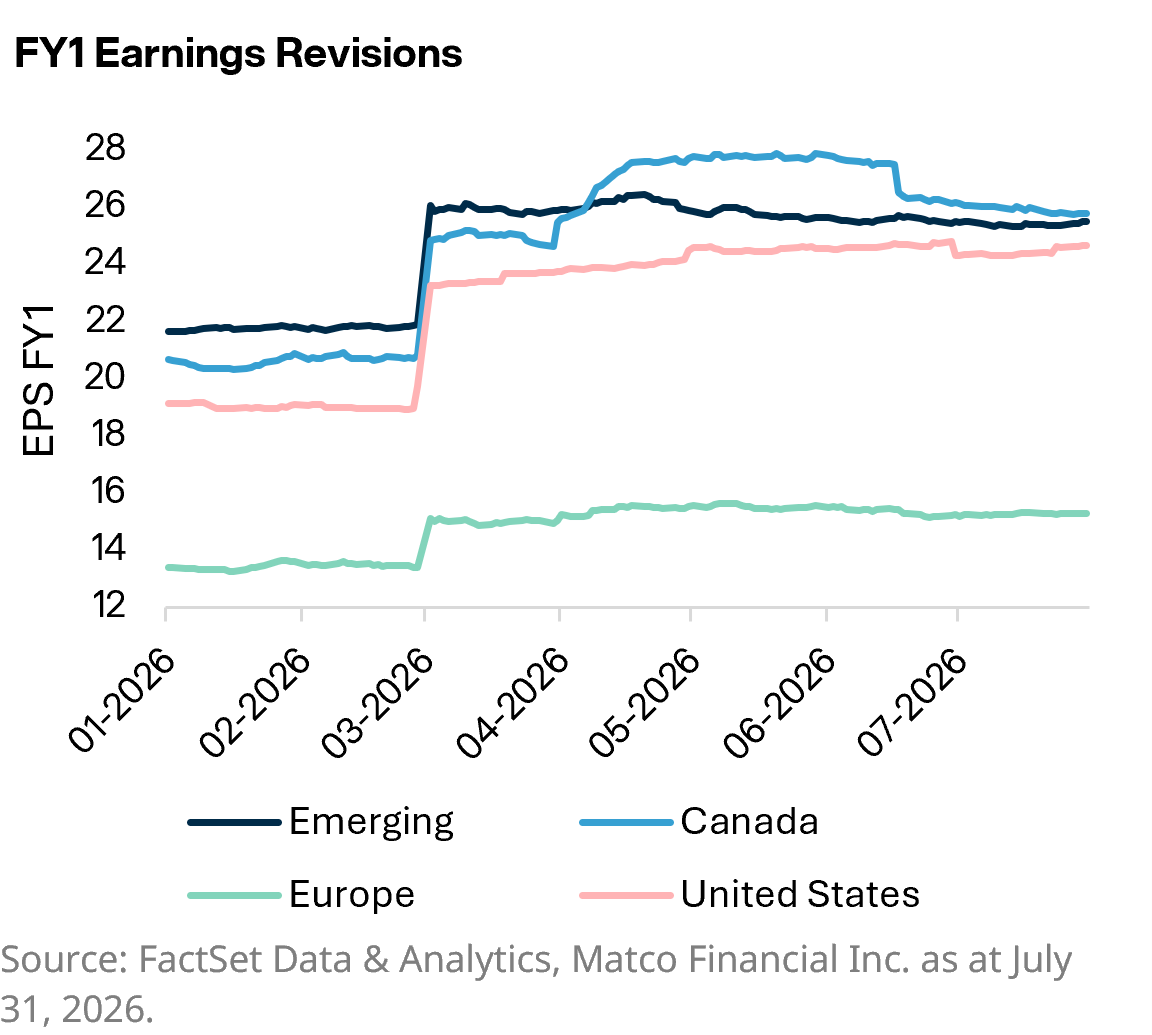
Second-quarter financial reports have been strong. The results have not been limited to large technology businesses. We have also seen good numbers from financial companies, consumer discretionary businesses and individual health care companies.
As of July 31, the expected year-over-year revenue growth rate in 2026 for the FactSet US index had risen to 10.5% from 8.0% at the end of March. Meanwhile, the expected earnings growth in 2026 also rose to 27.1% from 19.3% in March. In terms of sectors, Technology Services, Electronic Technology, Finance, and Energy Minerals all reported second quarter earnings above analysts’ estimates so far, with the latter three also exceeding revenue estimates.
That matters because earnings provide the fuel that can help markets move through difficult conditions. Higher rates, geopolitical tension and uncertain trade policy can all create resistance, but companies that continue growing their sales, margins and cash flows have a better chance of overcoming that resistance.
There has also been a subtle improvement in valuation.
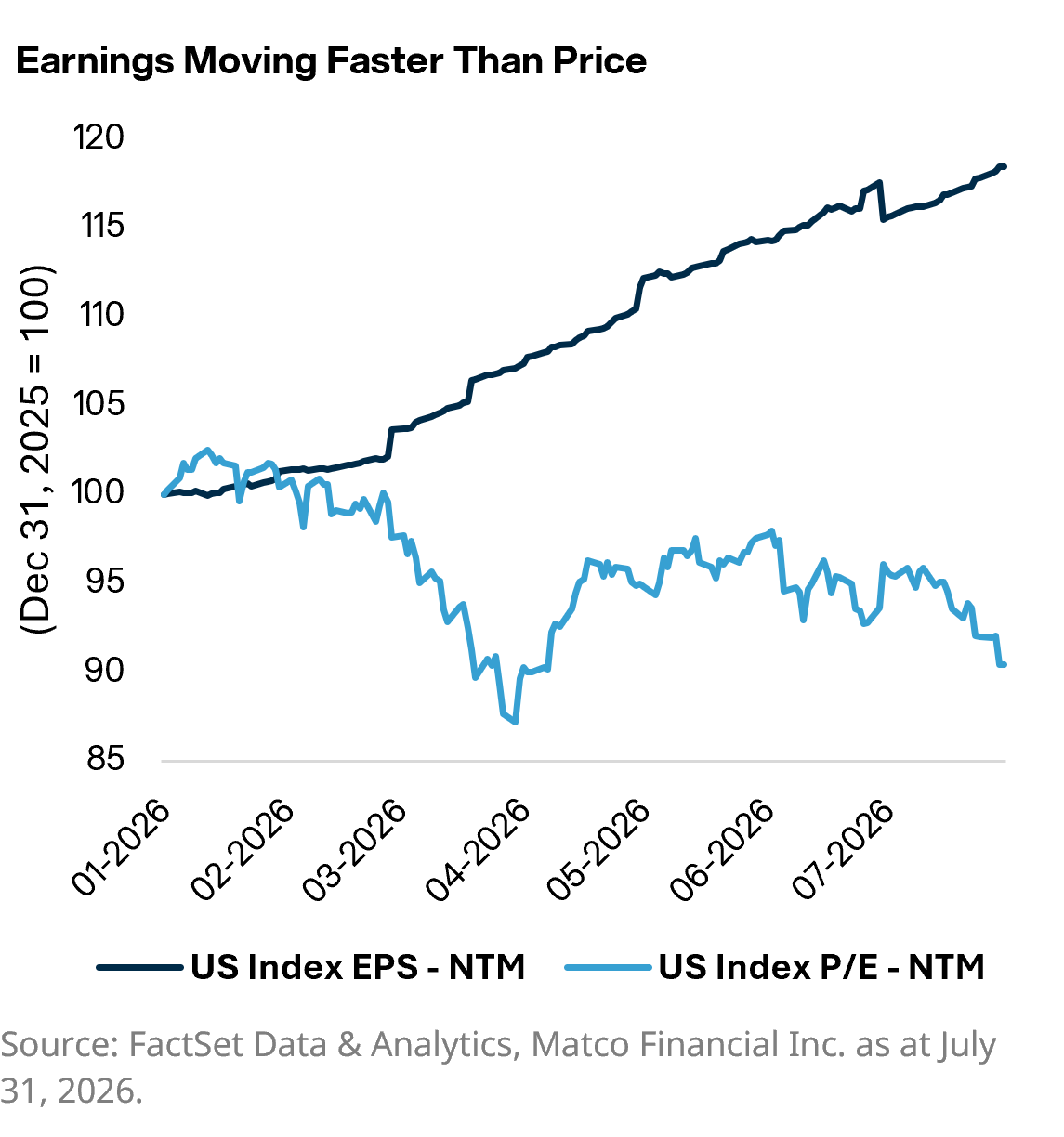
The forward price-to-earnings ratio for the FactSet US Index declined from 22.1 times at the end of December 2025 to 20.0 times by July 31. This did not happen because stock prices collapsed. It happened because forward earnings moved faster than prices.
This is the healthiest way for a valuation concern to resolve itself. Instead of requiring a sharp drop in prices, stronger earnings can slowly catch up to the market.
Earnings Moving Faster Than Price
The market is still not cheap. The forward valuation remains above its five- and ten-year averages. But valuation should never be viewed in isolation. As we discussed in last summer’s newsletter, a higher valuation supported by growing earnings is different from a higher valuation supported primarily by investor enthusiasm.
Dial Two: Interest Rates
The interest-rate dial is giving us a less favorable reading.
The Federal Reserve has maintained its target rate at 3.50% to 3.75% since the beginning of the year. Inflation remains above its longer-term 2% objective, with recent supply pressure - including energy prices - giving the central bank another reason to remain cautious.
The bond market has also moved.
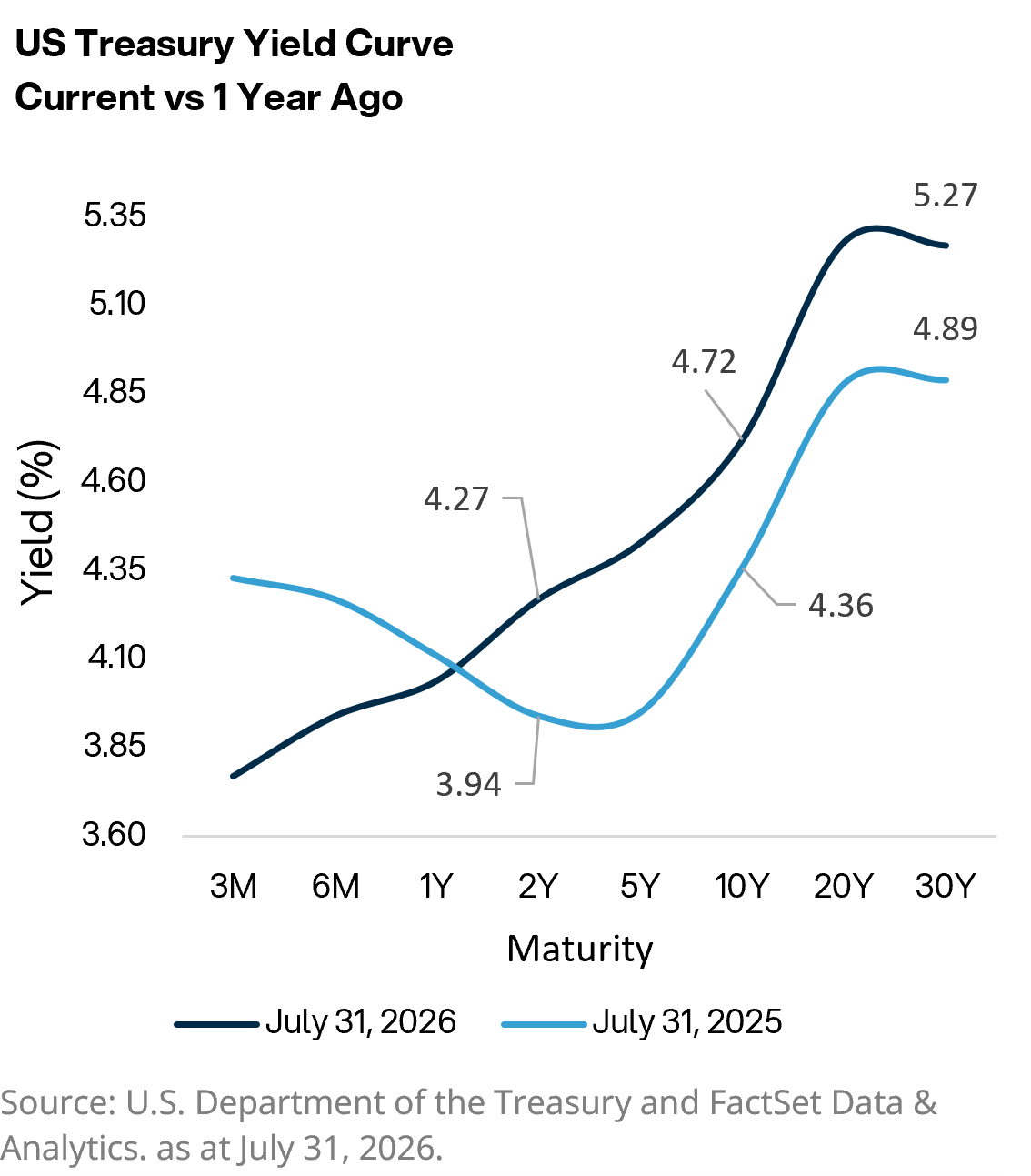
On July 31, the two-year U.S. Treasury yield was approximately 4.3%, while the ten-year yield was 4.7%. The ten-year yield had risen from 4.5% on July 2.
This tells us two things.
First, financial conditions are modestly restrictive. Companies, consumers and governments are paying more to borrow than they did during the low-rate period investors became accustomed to.
Second, longer-term interest rates are influenced by more than the next Federal Reserve decision. Inflation expectations, government borrowing, economic growth, oil prices and geopolitical risk can all affect the longer end of the yield curve.
Central-bank rates are like the tide: they influence the valuation of nearly every financial asset. When rates rise, investors have more alternatives to equities, and the future earnings of a company are worth a little less in today’s dollars.
That does not mean equities cannot perform while rates remain elevated. They can. But the earnings dial needs to work harder.
This is the current trade-off. Interest rates are creating resistance, but strong earnings are providing enough horsepower to keep the market moving forward.
Dial Three: Sentiment
The third dial is sentiment, and this is usually the least stable.
Investor sentiment can change much faster than earnings or interest rates. Earnings are reported quarterly. Central banks typically move gradually. Emotion can change before lunch.
The latest American Association of Individual Investors survey is a good example. Bullish sentiment rose to 44.9% on July 15, above its historical average. One week later, it dropped to 29.6%. Over the same week, bearish sentiment increased from 32.9% to 42.3%.
The underlying economy did not transform in seven days. Investor emotion did.
Fund flows are telling a similar story. For the week ended July 22, combined mutual fund and exchange-traded fund data showed approximately $16.6 billion leaving equity funds. Domestic U.S. equity funds experienced $5.7 billion of outflows, while world equity funds received about $10.9 billion. Bond funds attracted approximately $11.9 billion.
Weekly fund-flow data can be noisy, so I would not use one week to make an investment decision. It does, however, demonstrate that investors are not universally chasing risk.
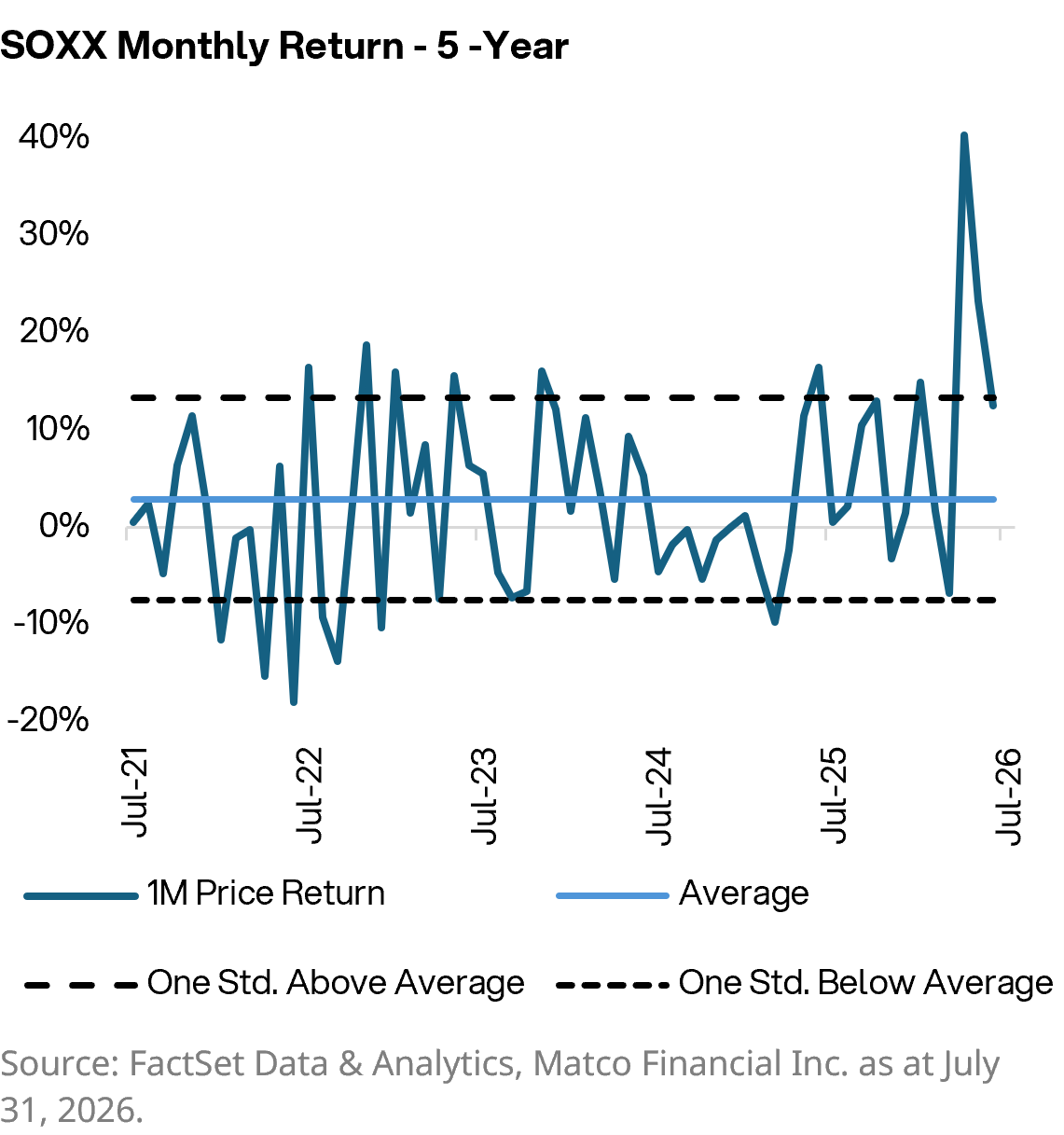
In my view, the cooling of parts of the artificial-intelligence trade in July is a positive development.
Strong investment themes can become unhealthy when momentum begins feeding more momentum. Prices rise because investors are excited, and that excitement attracts more buyers, which pushes prices higher again. Eventually, the relationship between price and the underlying business becomes stretched.
Some cooling allows investors to return to the important questions: Are earnings growing? Is the capital investment producing a return? Does the company have an advantage? What valuation are we paying?
Those are healthier questions than simply asking what has gone up the most.
What Does the Dashboard Say?
Earnings are green.
Interest rates are closer to yellow. They remain restrictive and are likely to keep pressure on highly valued or heavily indebted businesses.
Sentiment is moving quickly between optimism and caution. That is normal and, at times, useful. A market with some disagreement is healthier than one in which every investor is positioned for the same outcome.
This dashboard is not a market-timing tool. I’ll say it again - it is not a market-timing tool.
We introduced a similar idea in January 2025 when discussing Matco’s Investment Horizon Indicator and the market’s “messy middle.” The objective was not to predict the market’s next move. It was to create a disciplined way to assess whether the environment was becoming more or less favorable for taking risk.
The three-dial framework serves the same purpose and is the fundamental driver of the Matco Investment Horizon Indicator.
Matco’s Positioning
Trading activity within the Matco Global Equity Fund was low during July, and we made no material changes to the portfolio.
Low activity should not be confused with low attention.
We continue to review company results, analyst estimate revisions, valuations and the return businesses are generating on their capital. The strong reporting season has supported our conviction in the portfolio, while higher interest rates reinforce the importance of balance-sheet strength, growing cash flows and reasonable valuations.
Not every month requires action. Active management also means recognizing when the portfolio is positioned appropriately and allowing the underlying businesses to execute.
The many risks investors are discussing today are real. Inflation, geopolitical conflict, debt, oil prices and the sustainability of artificial-intelligence investment deserve attention.
They do not, however, deserve exclusive attention
The Bottom Line
There is never a perfect market.
Today, strong earnings are helping equities power through the difficulties created by higher interest rates. Sentiment remains fluid, and the cooling of some of the most popular artificial-intelligence investments is a constructive development rather than an automatic warning sign.
The dashboard is not completely green, but it does not need to be.
For prudent investors, the appropriate response is not to react to every forecast or headline. It is to remain diversified, stay close to the target asset allocation and focus on businesses whose earnings and cash flows can continue to grow through a range of market conditions.
Disclaimer
Matco Financial is an independent, privately held discretionary investment counsellor & asset management firm that serves the needs of individual investors, institutions, advisors, trusts, corporations and not-for-profit organizations.
Matco provides investment advisory services to investors on a discretionary basis through mutual funds and separately managed accounts. This communication is intended for information purposes only and does not constitute an offer or solicitation by anyone in any jurisdiction in which such an offer or solicitation is not authorized or to any person to whom it is unlawful to make such and offer or solicitation.
All statements that look forward in time or include anything other than historical information are subject to risks and uncertainties and are not guarantees of future performance. Investors should not rely on forward looking statements. Actual results, actions or events, could differ materially from those set forth in the forward looking statements.
Where the Net Asset Value ("NAV") price or performance of a particular series of a fund is displayed, other series are available; and fees, NAV price and performance may differ in those other series.
Performance returns for the Matco Mutual Funds are calculated by Matco Financial Inc. These returns are calculated and reported in Canadian dollars and are historical simple returns for the 3 month, YTD and 1 year periods and annualized compounded total returns for periods after 1 year. They include changes in unit value and reinvestment of all distributions and do not take into account sales, redemption, distribution or optional charges or income taxes payable by any security holder that would have reduced returns. Matco Fund returns for Series F units are calculated after management fees and operating expenses have been deducted. Matco Fund returns for the Series O units are calculated after operating expenses have been deducted. Series O unit management fees are charged separately outside of the fund. Matco Fund returns are calculated after management fees and operating expenses have been deducted. In comparison, the index returns do not incur management fees or operating expenses. Index returns are supplied by a third party. We believe the data to be accurate, however, we cannot guarantee its accuracy.
Commissions, trailing commissions, management fees, brokerage fees and expenses all may be associated with mutual fund investments. Please read the Fund Facts and Prospectus before investing. Mutual funds are not guaranteed, their values change frequently, and past performance is not indicative of future performance. Matco Funds are not available for purchase in Quebec, Newfoundland & Labrador, PEI, New Brunswick or the Territories.