
Interest rates are down.
Unless, of course, you need to borrow money for more than a few months.
That sounds contradictory, but it captures what has happened in the U.S. Treasury market over the last year. Short-term rates have declined as monetary policy has become less restrictive. Move further out on the yield curve, however, and the story changes considerably.
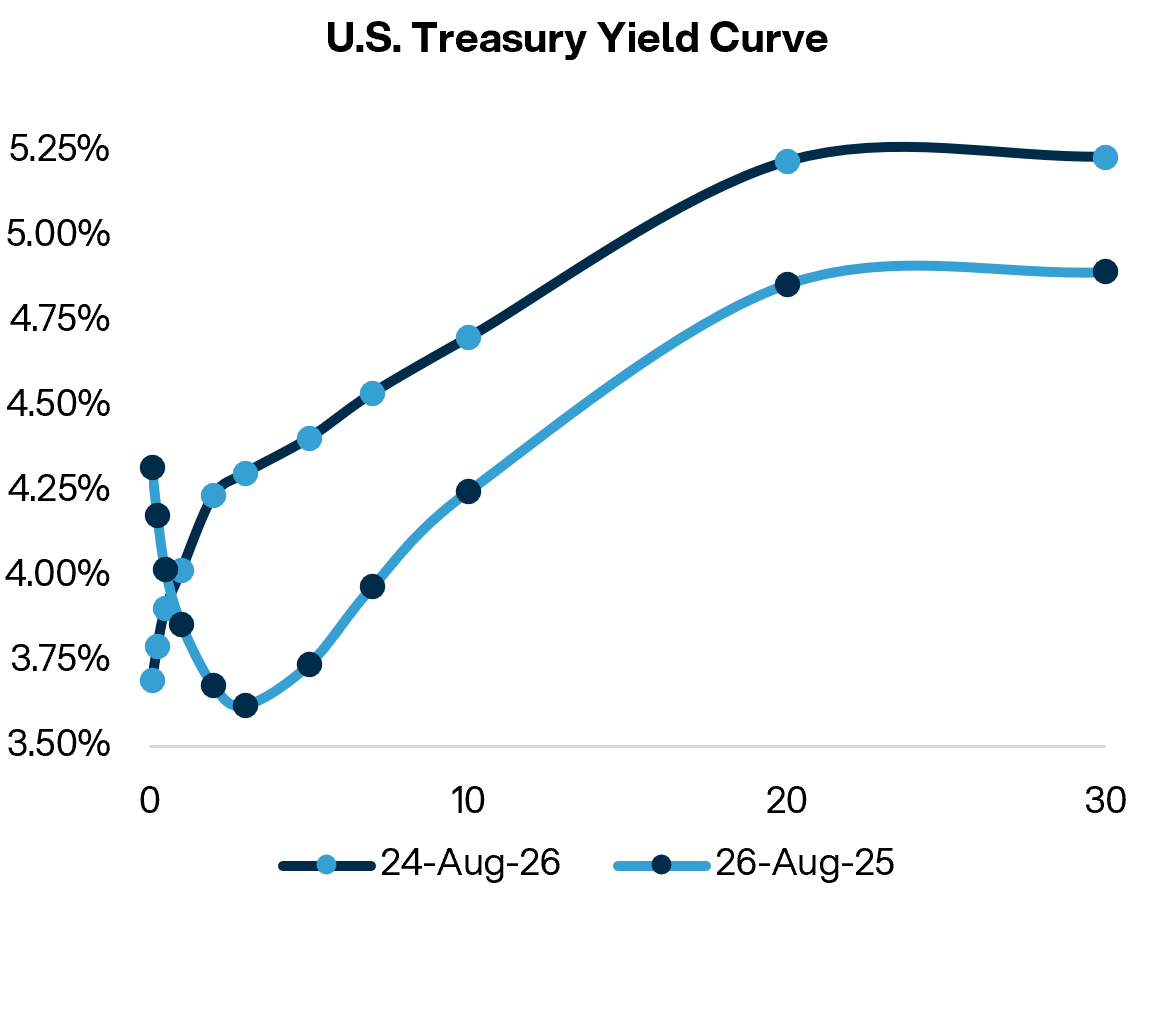
As of August 24, the 1-month U.S. Treasury yielded approximately 3.69%, down 65 basis points from a year ago. The 10-year Treasury yielded 4.70%, up about 45 basis points, while the 30-year sat at approximately 5.23%.
Source: FactSet Data & Analytics, Matco Financial Inc. as at August 24, 2026.
Said another way, the Federal Reserve has provided some relief at the very front of the curve, but capital has not become cheap again.
For equity investors, I believe that distinction matters.
Source: FactSet Data & Analytics, Matco Financial Inc. as at August 26, 2026.
Two Messages From the Same Curve
In October of last year, I compared central bank rates to the tide — raising or lowering financial conditions across markets. The analogy still works, but today there is an important wrinkle.
The Federal Reserve has considerable influence over the very short end of the interest-rate market. Investors determine much more of what happens further out.
At its July meeting, the Federal Reserve held its target range at 3.50%–3.75%. The Fed also described economic activity as expanding at a solid pace, with strong productivity growth and capital investment, while inflation remained elevated relative to its 2% objective.
That combination helps explain why the yield curve is sending two messages.
The first is relatively constructive: short-term monetary pressure has eased from where it was a year ago.
The second requires more discipline: investors are demanding considerably more compensation to lend money for five, ten or thirty years.
The 3-month to 10-year portion of the curve illustrates the change. Today, the 10-year Treasury yields roughly 91 basis points more than the 3-month Treasury. A year ago, that gap was only about 7 basis points.
Importantly, not every part of the curve has steepened. The 10-year yield is currently about 47 basis points above the 2-year yield, versus roughly 56 basis points a year ago. That portion of the curve has actually flattened modestly.
The real change is between cash and longer-term capital. We think that is the more useful observation for investors.
The Equity Hurdle Rate Has Moved Higher
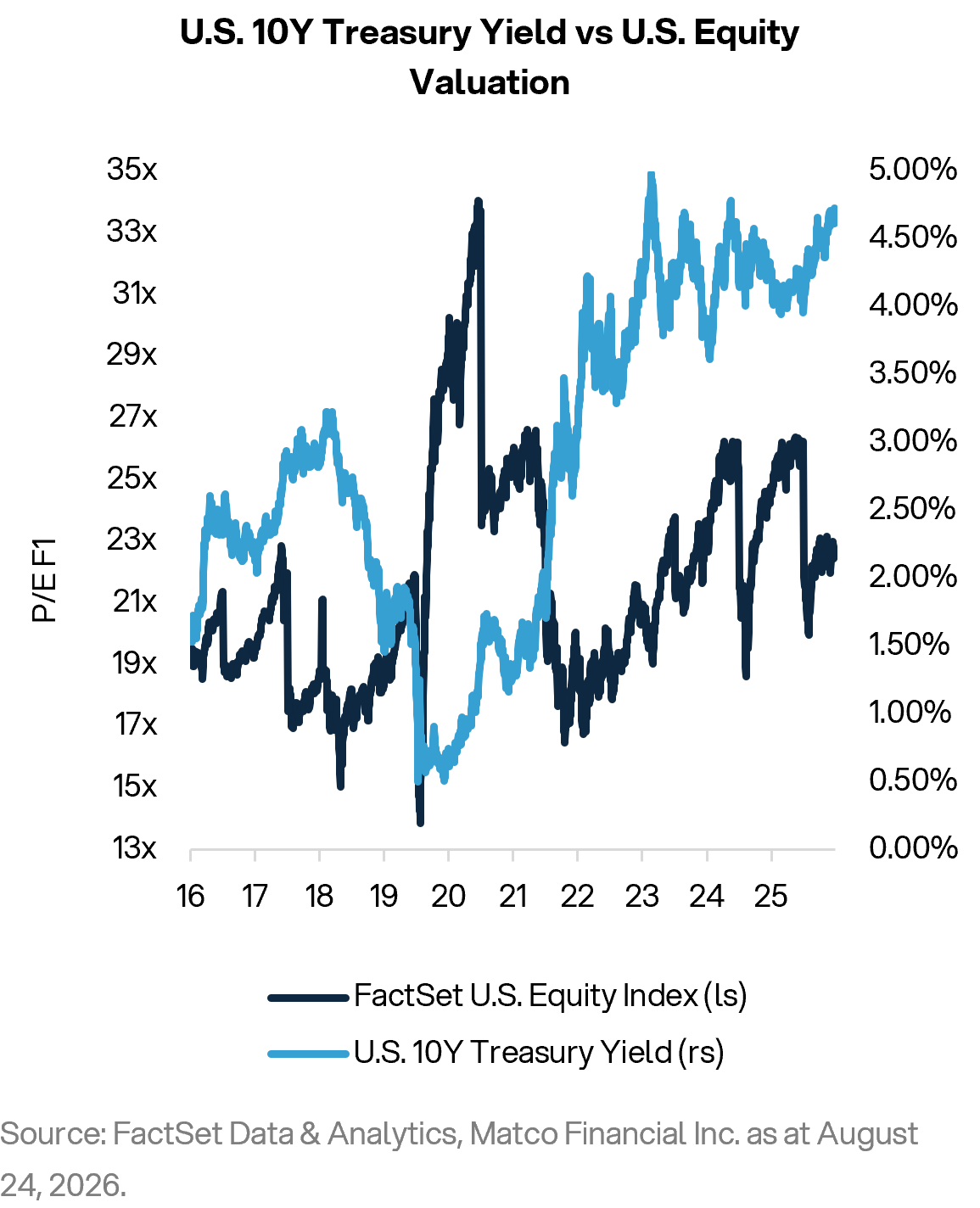
A 10-year U.S. Treasury yielding around 4.7% begins to give allocators of capital a credible alternative to equities.
That does not make equities unattractive. It simply raises the standard.
A company trading at a premium valuation needs to demonstrate why an investor should continue to pay that premium. We want to see sustainable earnings growth, free-cash-flow generation, a strong balance sheet and returns on invested capital comfortably above the company's cost of capital.
This is where our growth-at-a-reasonable-price philosophy becomes particularly relevant.
Pure value can be cheap for a reason — earnings may be deteriorating. At the other end of the spectrum, pure growth can become vulnerable when investors are paying today for cash flows expected many years into the future.
Our goal is to balance those two conflicting styles.
We want to be paid for the growth we can underwrite rather than paying today for growth that may not arrive for several years.
Higher long-term interest rates make that distinction more important because earnings have duration too. A company already producing attractive earnings and free cash flow is less dependent on distant assumptions than a business whose investment case relies heavily on profits five or ten years from now.
Source: FactSet Data & Analytics, Matco Financial Inc. as at August 24, 2026.
This does not mean abandoning equities. Far from it.
It means the growth needs to be real, the cash flow needs to follow, and the valuation needs to leave some room if everything does not go perfectly.
There Is Another Buyer of Capital
There is another piece of the long end of the yield curve that deserves attention: the U.S. government.
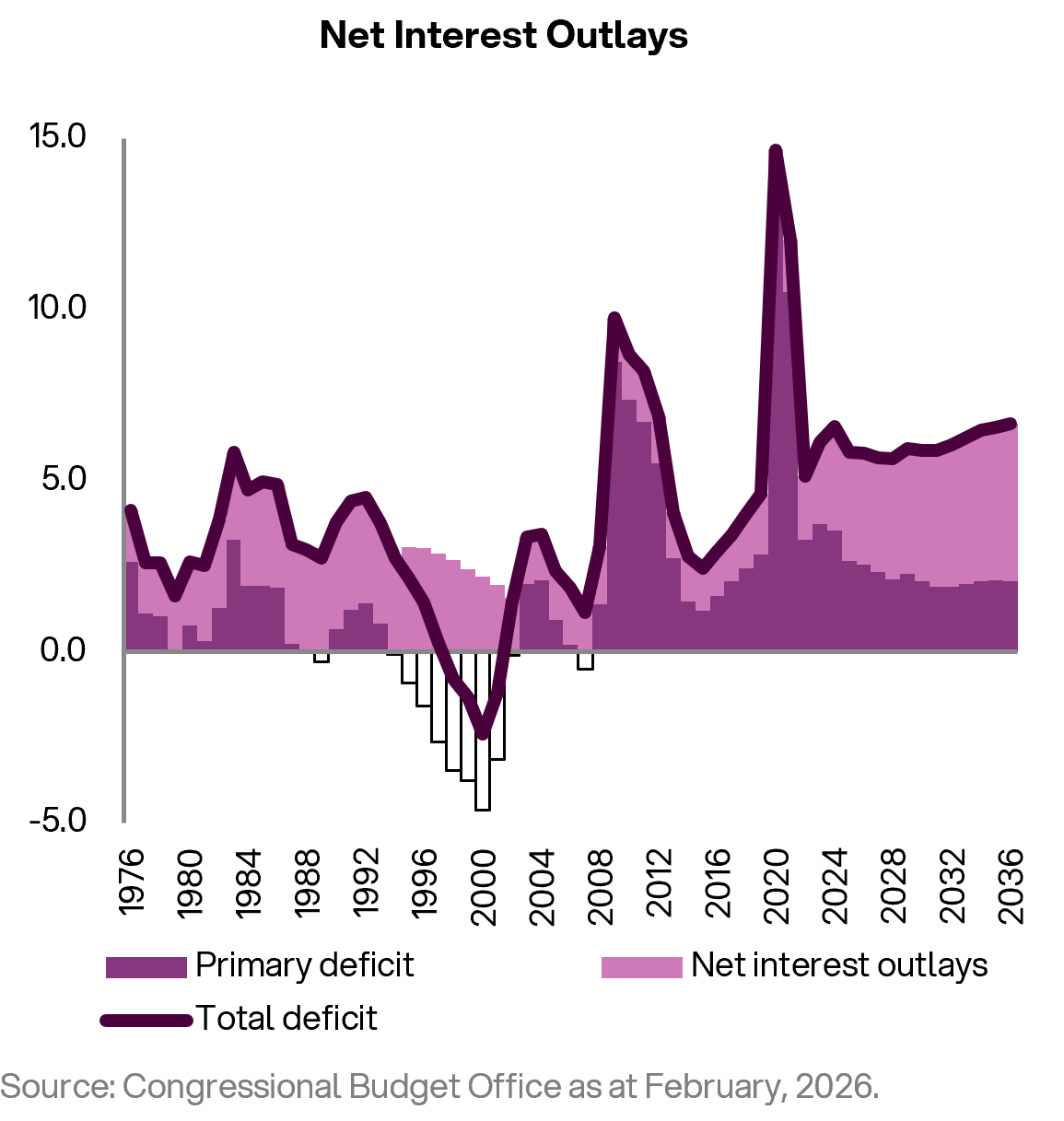
The Congressional Budget Office projects federal debt held by the public at approximately 101% of U.S. GDP in 2026, rising to 120% by 2036. Net interest outlays are projected to increase from roughly $1.0 trillion this year to $2.1 trillion in 2036, when they would account for nearly one-fifth of federal spending.
Those are big numbers.
The U.S. Treasury also expects to borrow $739 billion in privately held net marketable debt during the July-to-September quarter and another $628 billion in the final three months of 2026.
Does that mean the U.S. has reached a point of no return?
We do not think that is the right conclusion.
There is no magic debt-to-GDP number where a country suddenly becomes insolvent. The U.S. borrows in its own currency, operates the world's deepest government bond market and remains central to the global financial system.
But that does not make debt accumulation risk-free.
A better way to think about it is as a gradual pressure on the financial system. Large deficits require more Treasury issuance. More issuance competes for capital. Investors will demand greater compensation to own long-term government debt, particularly if inflation remains elevated.
The Federal Reserve can lower overnight interest rates. It cannot guarantee that investors will lend money to the U.S. government for 30 years at the same rate, despite open market purchases of long dated bonds.
That may be one part of what the long end is telling us today.
Source: Congressional Budget Office as at February, 2026.
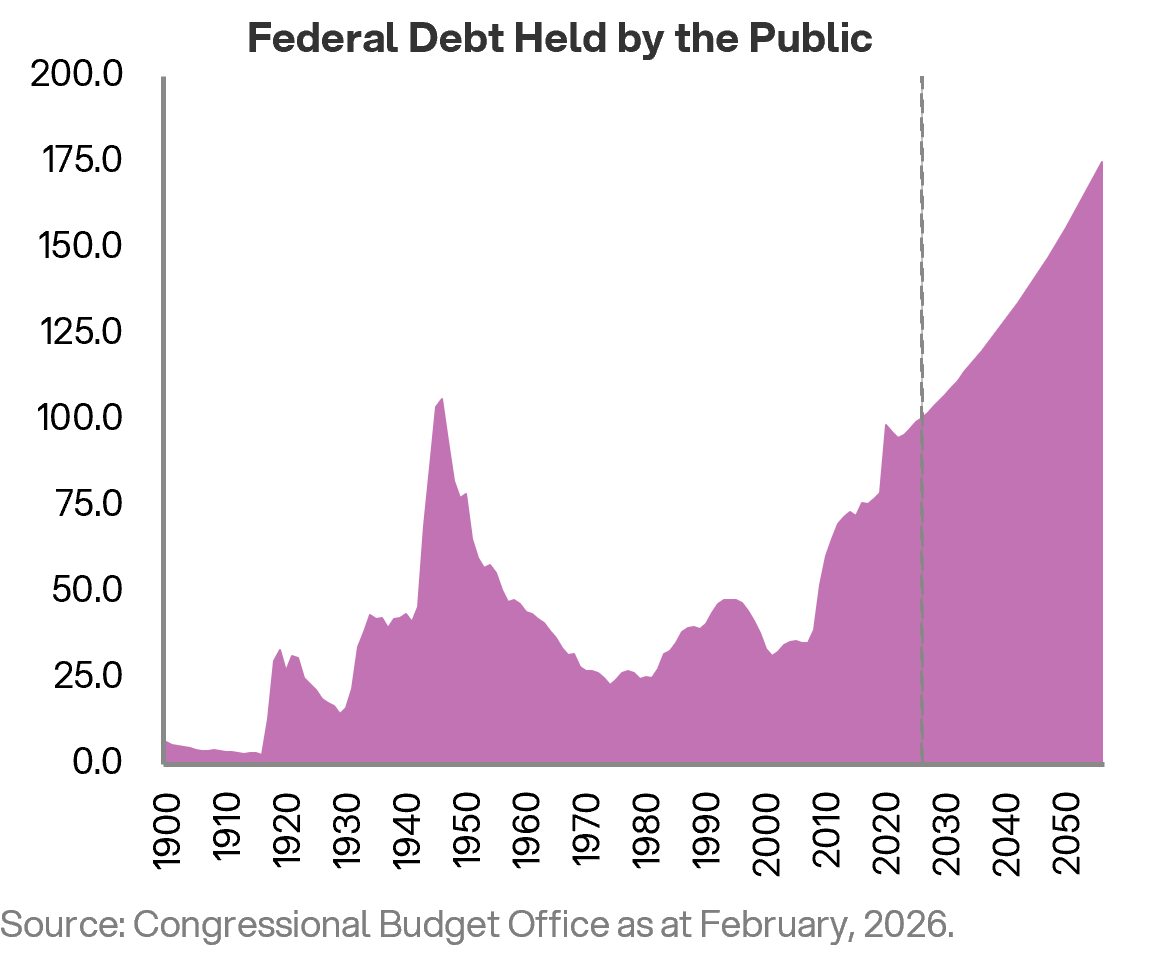
Source: Congressional Budget Office as at February, 2026.
The concern is less about an imminent debt crisis and more about the possibility that large government borrowing keeps long-term interest rates higher and more volatile than investors became accustomed to in the decade following the Global Financial Crisis. This higher borrowing cost for the U.S. government will force fiscal restraint eventually; however, that inflection point is at higher rates then we are seeing today.
What Does This Mean for the Matco Global Equity Fund?
For us, the answer is not to make a large bet on the direction of interest rates.
It is to own businesses where the investment thesis does not require substantially lower rates to work.
Booking Holdings is a useful example from the portfolio.
According to our August 25 FactSet screen, current estimates call for approximately 9.4% FY2 sales growth, while the shares trade at roughly 14.5 times FY2 free cash flow.
That combination is a good illustration of what we mean by growth at a reasonable price.
Booking is a high-quality, cash-generative business where the investment case is based on the ability of the underlying company to grow and convert that growth into cash — not on the hope that interest rates fall and the valuation multiple expands.
The business does not need to be the fastest grower in the portfolio to be attractive. What matters is the relationship between the growth we can underwrite, the cash flow that growth produces and the price we are being asked to pay for it.
That is the same framework we apply across the Matco Global Equity Fund.
Higher rates make balance-sheet strength, cash conversion and capital allocation more important. They also make valuation discipline harder to ignore.
In our view, that is a healthy environment for active stock selection.
The Bottom Line
The yield curve is not flashing an economic red light today.
Short-term monetary pressure has eased. Economic activity remains relatively resilient. But the bond market is also reminding us that lower short-term rates do not automatically mean a return to cheap long-term capital.
Bonds now provide meaningful income, which raises the standard equities must meet.
From my perspective, that makes the investment framework fairly straightforward: focus on businesses capable of growing earnings and free cash flow without depending on leverage, falling rates or ever-higher valuations.
Booking Holdings provides one example of that balance — visible growth, strong cash generation and a valuation we believe remains reasonable relative to the opportunity.
The higher risk-free rate does not eliminate the equity opportunity.
It simply makes the price we pay for growth more important.